A Brief History of Workplace Design
Where and how we work has been shaped by economic forces, cultural values, and, crucially, architectural design decisions. From the open-plan factory floors of the early 20th century to today's hybrid and remote work arrangements, the workplace has undergone radical transformations.
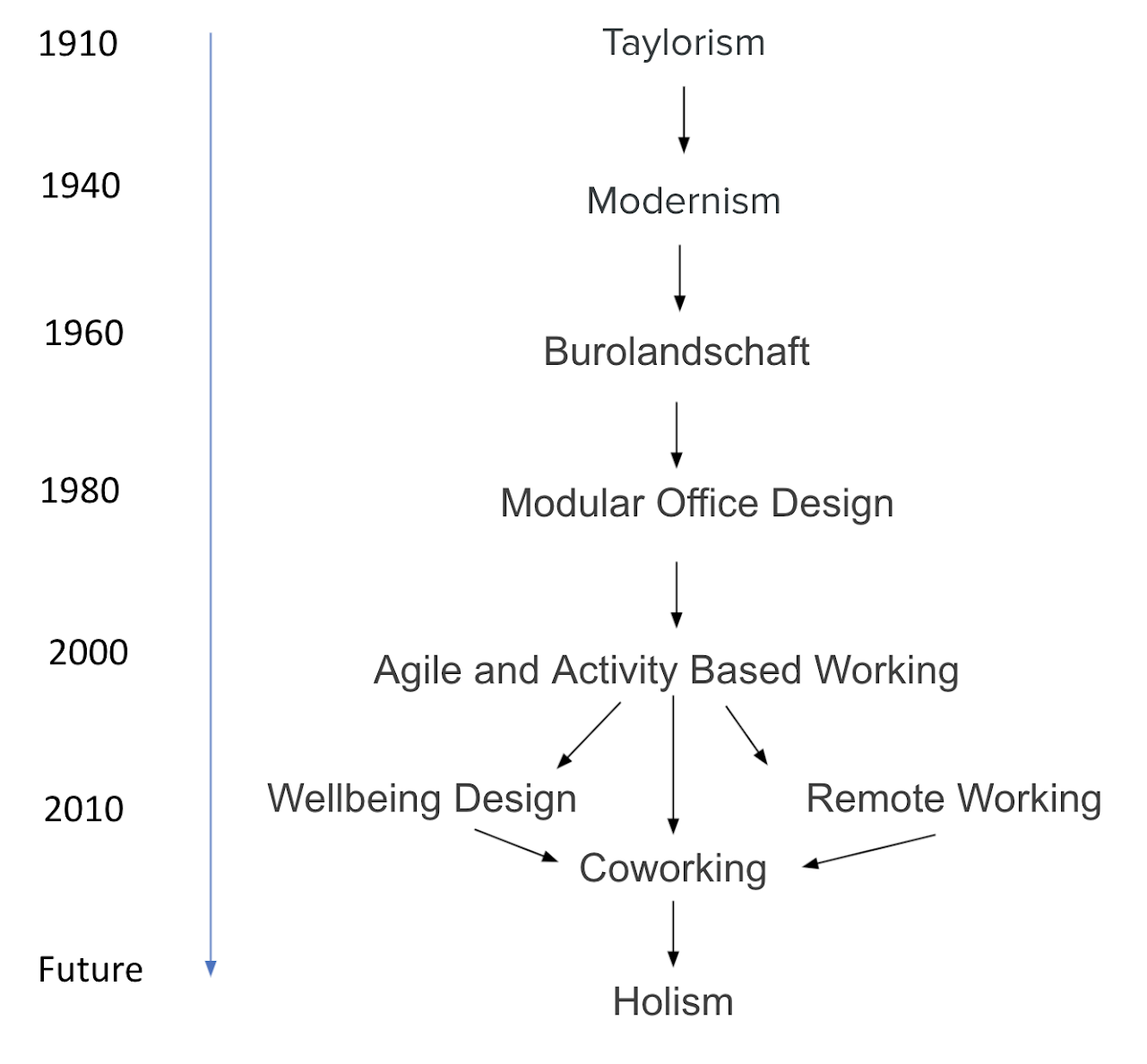
Taylorism
Scientific management applied assembly-line logic to office work. Rows of desks, hierarchical supervision, minimal worker autonomy.
Burolandschaft
The German "office landscape" rejected hierarchical layouts in favor of organic, open arrangements based on communication patterns.
Action Office & Cubicles
Herman Miller's Action Office was intended to give workers privacy and flexibility. In practice, it devolved into the cubicle farm.
Hybrid & Remote
Technology has decoupled work from place. The pandemic accelerated experiments with remote, hybrid, and "third place" work models.
From Workspace to Workplace
A workspace is a physical setting. A workplace is a meaningful environment. The distinction matters because design can transform one into the other. When workers feel a sense of belonging, autonomy, and purpose in their environment, productivity and well-being improve. This is the core argument of placemaking in organizational contexts.
"We shape our buildings; thereafter they shape us." - Winston Churchill
Placemaking at Work
Sara's doctoral research focuses on Placemaking at Work: the process by which physical workspaces are transformed into meaningful workplaces. Drawing from architectural theory, environmental psychology, and organizational behavior, the research examines how design strategies can foster:
Sense of Place
Workers develop attachment to their environment when design supports their identity, social interactions, and daily rituals. This is especially challenged in remote and hybrid models where "place" is fragmented across home, office, and third spaces.
Sustainability & Environmental Impact
Using the IPAT equation (Impact = Population x Affluence x Technology), the research evaluates the environmental implications of different work models. Does working from home reduce carbon emissions? Or does it simply redistribute them? The answers are more nuanced than most corporate sustainability reports suggest.
Flexible Design Strategies
Smart buildings, modular furniture systems, adaptive reuse, and technology-enabled environments are explored as tools for creating workplaces that can evolve with changing work patterns while maintaining their capacity for placemaking.